
Peptide Syringes: Sizes, Units & Measurement Guide
How insulin-style syringe sizes, gauges and unit markings work for measuring a research peptide solution — plain-English, non-medical, and clear about what's a device fact versus a community preference.
Updated 12 Sep 2026
Quick Summary
- Type
- Equipment & measurement guide
- Evidence Stage
- Device specifications and recurring community discussion — not clinical or medical guidance
- Common Research Areas
- Syringe measurementReconstitutionLaboratory preparation
- Current Status
- Reference guide — equipment characteristics only, not an injection or dosing guide
- Related Products
- Bacteriostatic Water
Why Insulin-Style Syringes Come Up in Peptide Research
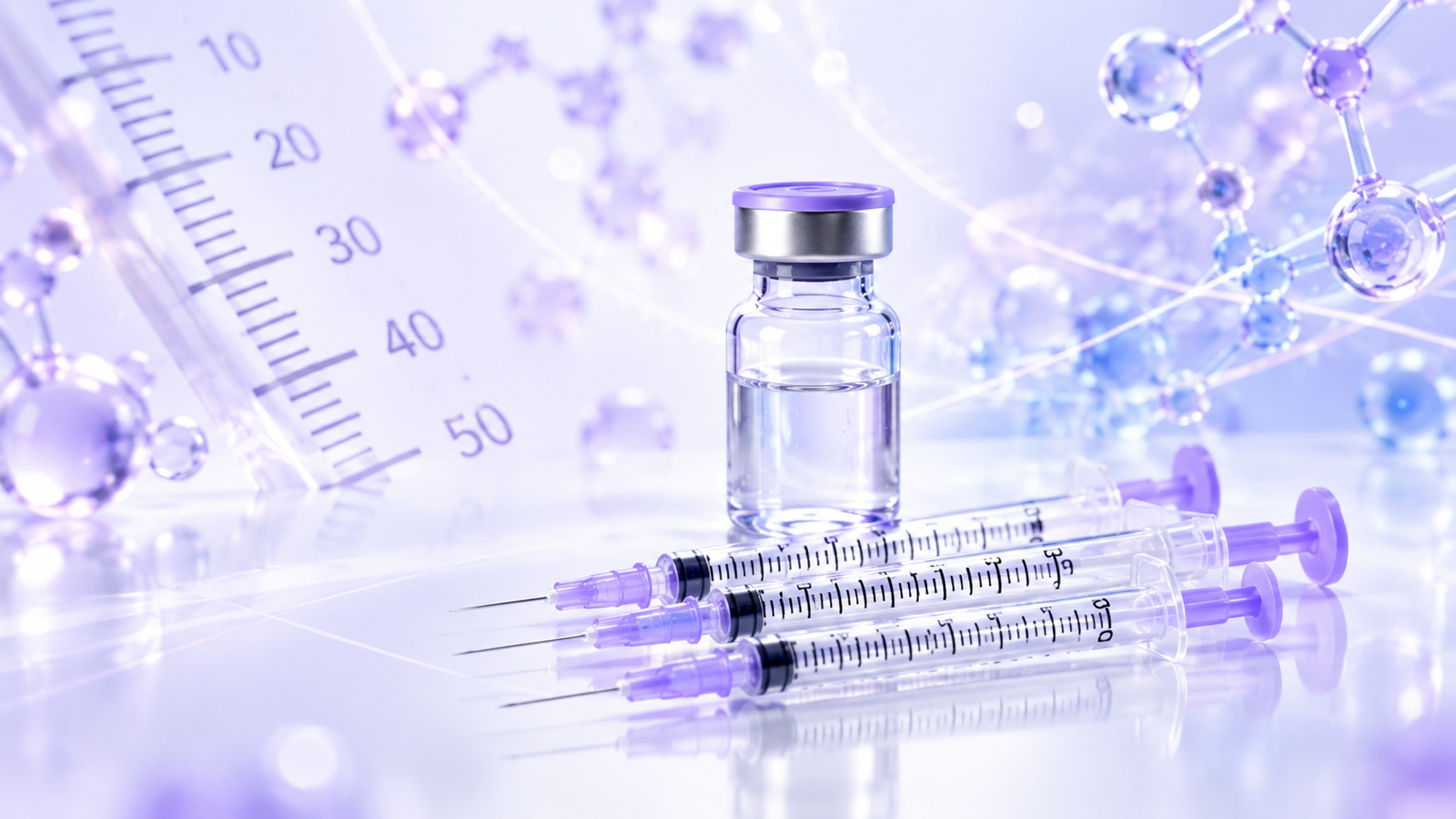
When peptide communities discuss syringes, they're almost always talking about small insulin-style syringes rather than standard Luer syringes — a fixed, fine needle built onto a narrow barrel marked in fine, evenly spaced units. That design exists to measure small volumes precisely, which is exactly the kind of measurement involved once a freeze-dried peptide has been reconstituted into a liquid. Larger-bore needles, intramuscular equipment and general injection technique are a different topic and outside what this guide covers.
Barrel Size: 0.3 ml, 0.5 ml and 1 ml
Insulin-style syringes commonly come in three capacities: 0.3 ml (30 units), 0.5 ml (50 units) and 1 ml (100 units). All three are marked on the same U-100 scale — 100 units per millilitre — but that scale is stretched over a different barrel length in each case. On a 1 ml syringe, each printed line typically represents 2 units; on a 0.3 ml or 0.5 ml syringe, the same unit range is spread across a shorter barrel, so each unit occupies more physical space on the scale. That's why smaller barrels are commonly discussed as easier to read precisely for small draws, while a 1 ml syringe is generally preferred when the draw volume is larger. This is a mechanical fact about how the markings are spaced, not a claim that any one size is correct for a given situation.
How Units Relate to Volume
A U-100 insulin syringe is marked so that 100 units equals 1 ml, meaning 10 units equals 0.1 ml and 1 unit equals 0.01 ml. In practice: units = millilitres × 100. That conversion only tells you something useful once you know the concentration of the solution in the syringe, which depends on the peptide amount in the vial and how much liquid it was reconstituted with — see the next section.
Needle Gauge: What 30G, 31G and 32G Mean
Gauge is a standard sizing system for needle wall thickness — counterintuitively, a higher gauge number means a thinner needle. Peptide communities commonly discuss syringes in the 30G-to-32G range, all of which count as fine needles suited to low-viscosity, small-volume liquids. Within that range, discussion of 31G versus 32G is mostly about draw speed and comfort rather than one being definitively better: thinner, higher-gauge needles are generally discussed as slower to draw a viscous liquid through, while a slightly thicker, lower-gauge needle draws a little faster. Neither is presented here as the medically correct choice — it's a preference discussed within a narrow, already-fine range.
Needle Length: Why Short Needles Come Up
Short, fine insulin-style needles in roughly the 4–8mm range are commonly discussed in peptide communities, generally paired with the 30G-or-finer gauges above. Longer needles, drawing needles and intramuscular injection equipment come up in a completely different context and are outside the scope of this guide — this article doesn't cover injection sites, depth, technique or dosing of any kind.
Fixed vs Removable Needles
An insulin-style syringe's needle is fixed directly onto the barrel, rather than attached separately as with a standard Luer-tip syringe and needle. That fixed design leaves almost no unused space ("dead space") between the plunger's full travel and the needle tip, whereas a separate, removable needle leaves a small amount of liquid trapped in the hub that the syringe can't push out. For small, precisely-measured volumes, that's why fixed-needle insulin syringes are the type most often discussed in peptide communities, rather than a syringe-and-needle combination bought separately.
Volume, Concentration and the Reconstitution Calculator
A syringe only tells you a volume — it has no way of knowing your solution's concentration. That comes from how much peptide is in the vial and how much liquid was added to reconstitute it, and it's the actual number that turns a target amount into a unit reading on your syringe. Rather than working that out by hand, our Reconstitution Calculator takes the vial strength, the water volume used and your target amount, and returns the exact syringe reading directly.
What's in the Research Starter Pack
If you're putting together equipment for the first time, our Research Starter Pack contains five 1 ml (100-unit) syringes with a fixed 32G x 8mm needle, plus alcohol prep wipes — sitting within the ranges discussed above rather than at either extreme. Paired with Bacteriostatic Water for reconstituting a freeze-dried vial before you measure anything.
Scope of This Guide
This article covers syringe equipment and measurement only: sizes, markings, gauge, length and how they relate to volume and concentration. It does not cover injection sites, depth, technique, dosing amounts or dosing schedules, and nothing here should be read as medical or veterinary guidance. Where community preferences are described, they're presented as recurring discussion patterns, not as scientific proof or a recommendation — for authoritative device specifications, refer to the manufacturer's own documentation.
Frequently Asked Questions
What size syringe is commonly discussed in peptide communities?
What does 30G, 31G or 32G mean?
Why do people mention 4–8mm needle lengths?
Does this article explain how to inject anything?
How do I know how many units to draw?
Related products

For research use only.
Our products are supplied for laboratory and in-vitro research and are not intended for human or veterinary use. By ordering, you confirm you're a qualified researcher and will handle the material responsibly.